FEAPS 4
4. Assessment. The effective educator consistently:
a. Analyzes and applies data from multiple assessments and measures to diagnose students’ learning needs, informs instruction based on those needs, and drives the learning process


I analyzed and applied data from multiple assessments and measured to diagnose students learning needs by giving my students multiple assessments to identify what instruction my students needed. By giving my students a preassessment question, I was able to dentify the misconceptions that my students already had before diving deeper into the unit. I was able to address these misconception and then give my students another exit ticket to identify the progress. The lack of a model was not conducive to a lot of my students learning needs so for the last half of the unit, I taught the students a model to help them understand the concept. his helped them grasp the content easier and prepared them to take the units exam and successfully pass.
b. Designs and aligns formative and summative assessments that match learning objectives and lead to mastery

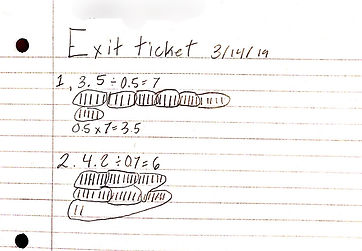

I designed and aligned fromative and summative assessment that matched learning objectives and lead to mastery by designing to exit tickets to see if my students had grasped the learning objectives. The learning objective for the unit was to model and solve problems involvig multiplying and dividing decimals. The students began to show me that they were grasping the content but were not quite ready to take the units test before spring break so I created a summative assessment that gave me a grade to put in the grade book that shows that my students have achieved mastery in this unit.
c. Uses a variety of assessment tools to monitor student progress, achievement and learning gains

I used a variety of assessment tools to monitor student progress, achievement, and learning gains when grouping the students in RTI groups. Alongside the grade level team, we looked at the students every day work but really used I-Ready to help us group the students into the appropriate tiers. It also gave us insight into what rate our students are academically growing at for a more realistic picture of what to expect from each of them. Looking at the I-Ready data allowed us to see what grade level our students are working at to give them the most beneficial instruction in their RTI group.
d. Modifies assessments and testing conditions to accommodate learning styles and varying levels of knowledge

I modified assessments to accomodate learning styles and varying levels of knowledge when I created a station view based off of my students learning styles and the strategies they have bee using. Students visited 5 different stations that highlighted one of the three main learning styles: visual, auditory, and kinesthtic. Students knew which learning style was being highlighted at each station and used their learning style strategies, implemented at the beginning of the year, when they were not at a station that was their strong suit. The student work from these stations was taken as an assessment grade allowing me to see if the students were ready to take the common exam or whether we needed to review for another day or two.
e. Shares the importance and outcomes of student assessment data with the student and the student’s parent/caregiver(s)

.jpg)
.jpg)
.jpg)
I shared the importance and outcomes of student assessment data with the students and the student's parents/caregivers by implementing a grade folder system. When the students complete assignments throughout the week,they log their grades in the respective sections. Weekly, the students take their folders home to be signed by their parents. They recieve rewards for coing back with the folder papers completely signed. With the lack of parental involvement at my internship school, I believed this would be an awesome system to help make the parents more aware of what grades their child is recieving so they are not surprised when the progress alert or report card comes out. This has helped stop angry phone calls and emails from parents who were surprised by their childs grades at the end of the nine weeks.
f. Applies technology to organize and integrate assessment information.

I applied technology to organize and integrate assessment information by using plickers to capture, analyze, and sort my students into different groups telling me which group studied with which aspect of the lesson. This takes a lot of hard work out of the assessment process and the students love to come and see there results when you conference with them.