


EDE 4944: Supervisor Observation #2 Lesson Plan/ Video Chart/ Reflection
- Darby Bernaldo
- Nov 1, 2018
- 6 min read



1. What aspects of your lesson were implemented differently than you planned? Why did that happen?
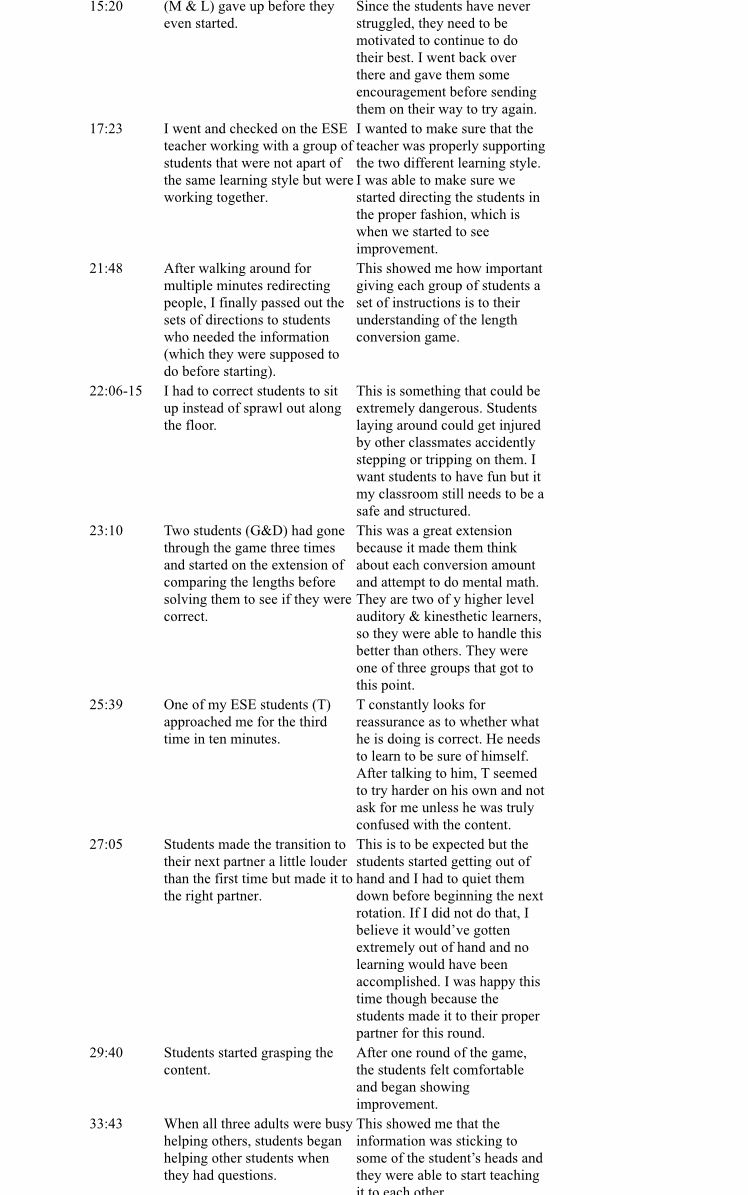
The aspects of my lesson that were implemented differently were revisiting day one on day two as well and how my assessment was delivered. After asking the students the prompting questions for the day two part of the lesson and getting blank stares, I decided the revisiting the things we talked about during day one would be in their best interest (0:56). I knew that length conversions were something new, but it baffled me how they could not make the connection to the times they are to use multiplication and the times they are to use division. I believe this happened because the students believe that the operations used to convert are different between time and length. I had the student copy down their conversion rules in their notebook next to their two conversion tables to help give them something to reference if they get confused again (3:50).
2. Of you were going to teach this lesson to the same group of students, what would you do differently? Why? What would you do the same? Why?
If I was going to teach this lesson to the same group of students, I would make them write the length conversion cheat sheet in their own notebook. Providing them with copies will beneficial but I believe they would have comprehend the information more if they wrote it themselves (2:34). This forces them to think about what they wrote and why they wrote it before even beginning the lesson. Another thing that I would do differently is model the game with an actual deck of cards and then relate it to the length measurement cards. The students did not make the connection between the card game war and the activity we were doing until at least more than half way into the activity (29:40). If they would have understood the connection sooner, I believe this would have made the first half of the activity more productive. Something that I would do the same is the activity. Even though the students were slow to understand, once they did, it was very beneficial to their understanding of length conversions. My CT even mentioned that according to the assessment data, the students did amazing which was something that she did not expect. I believe that because requires a lot of repetition, the students picked up on the concepts better than we thought they would (57:34).
3. What surprised you in your lesson?
One things that surprised my CT and I was how well the students did on the assessment (57:34). Like I previously mentioned, the students struggled greatly at the beginning of the activity and I thought that it would also reflect in their assessment (12:23-17:23). According to the Plickers data, the class scored an 80% on their first time doing length conversion word problems. Even my students who usually struggle with new material got 4 out of 5 or 5 out of 5 questions correct. I believe that the way they had to complete the activity, according to their learning style, helped them grasp the concept quicker.
4. Identify an individual or group of students who had difficulty in today’s lesson? How do you account for their performance? How will you help this (these) student(s) achieve the learning objectives?
Students who had difficulty with today’s lesson were M, P, T, I, and K. T, I, and K were students that I expected to have a difficult time with the new content. M and P were two students that were not completed with the assessment in time that shocked me (54:16). They are very intelligent individuals that can be lazy on occasion. I believe that this was one of their lazier days and they just wanted the answers to be told to them. I decided that the best option would be to remove these students from the room and send them next door. This way they could not hear any of the answers and they had to do it all on their own. Their ticket back into the classroom was all problem attempted for me to grade. I had to add their answers onto Plickers since they were not done in time to join the other students because of either their extended time or laziness. I do not believe that the lazy students will ever do that again because they were sad that they missed the Plickers portion. I will help these students achieve the learning objective by lining up a list of activities for my CT to do with not just these but all students that will help them master the content. After the students do all these activities, they will have not only mastered length but also weight and capacity. By next week the students should be ready to add it all together and play the review games that I already have planned.
5. Identify an individual or group of students who did especially well in this lesson today. How do you account for this performance?
An individual that did especially well in today’s lesson was J. J is an ESE student that receives help every day. Ever since I started in this classroom, he has been a constant struggle to manage do to his lack of attention and willingness to learn. In today’s lesson, the light switch just flipped, and he was very responsive, answered almost every practice question correct and got four out of five questions on the assessment correct (54:37). I believe that the way I planned the specific learning style activity was big help in J’s achievement in today’s lesson. Moving forward, I will continue modify lessons in this way for J and his group in hopes that I will continue to see great growth.
6. Based on what happened in this lesson, what do you plan to teach next to this class? Be sure to explain how you will use information from this evaluation in future lesson planning
Based on what happened in this lesson, I plan on teaching the next few types of customary conversions (time, capacity, and distance) in the same way. After the students were put in their proper groups (27:05), they settled into the activity and started to grasp the content better than I thought they would. Using the learning style methods and cheat sheets alongside the game, I believe that it helped them understand what type of units were bigger and smaller. They knew the proper conversion steps making it easier for them to convert everything correctly. If the students have a cheat sheet for every type of conversion, it will help them be more successful and master the content. A positive is they will always be able to refer to the sheets because they are pasted in the notebook.
7. What specific differentiated instruction strategies and assessments are used in this lesson?
The specific differentiated instruction strategy that I used in this lesson is small groups with learning styles (7:02). The students are becoming more comfortable with the way they learn so they are starting to adapt to the way they do the activities a lot better. We had to mix students into different groups this time because of absences but they each did their own part of the activity specifically for their learning style (17:23). This way was style effective according to the assessment data. I will make sure that I allow students to pick partners that are not in their learning style group, so they must do the work by themselves and not piggy back off of their partner. The VAK learning style groups are proving themselves to be an effective method of instruction in this classroom.
8. What FEAPs did you accomplish throughout this lesson?
The FEAPs that I accomplished during this lesson are 2i, 3d, 3i, 4f, and 5c. I accomplished 2i by using Google translate to communicate with one of my students who speaks little to no English. This is one of the reasons that I have been able to include her in all of the lessons I have taught. Using Google translate makes it easy for me to explain what the class is doing in a way she understands while allowing her to ask me questions if she is confused. I accomplished 3d by modifying the way the game was played prior to starting (8:58). After identifying the misconceptions that my students were showing, I was able to change the game to finding the smaller unit since they were struggling with when to use division and multiplication. This forced them to work on just multiplication before moving on to division. I accomplished 3i by walking around the classroom throughout the lesson and giving groups feedback specifically based on what they were struggling with (∞). Instead of making generalized comments that would potentially confuse others, I went up to each group and gave them exactly what they needed to be successful. I accomplished 4f by using Plickers to collect assessment data and organize students into groups based off what they struggled with to better help them understand the content later. Since they struggled with length conversions, there is a good chance they will struggle with all other conversions as well. The technological assessment data gives us the ability to tailor the information needed to each group. I accomplished 5c by collaborating with colleagues to set up the groups and effectively implement the instruction needed to see progression. After we evaluated the learning outcomes together, it made it easier to see what needed to be done moving forward.

Comments