


EDE 4940: Supervisor Observation #3
- Darby Bernaldo
- Apr 8, 2019
- 8 min read


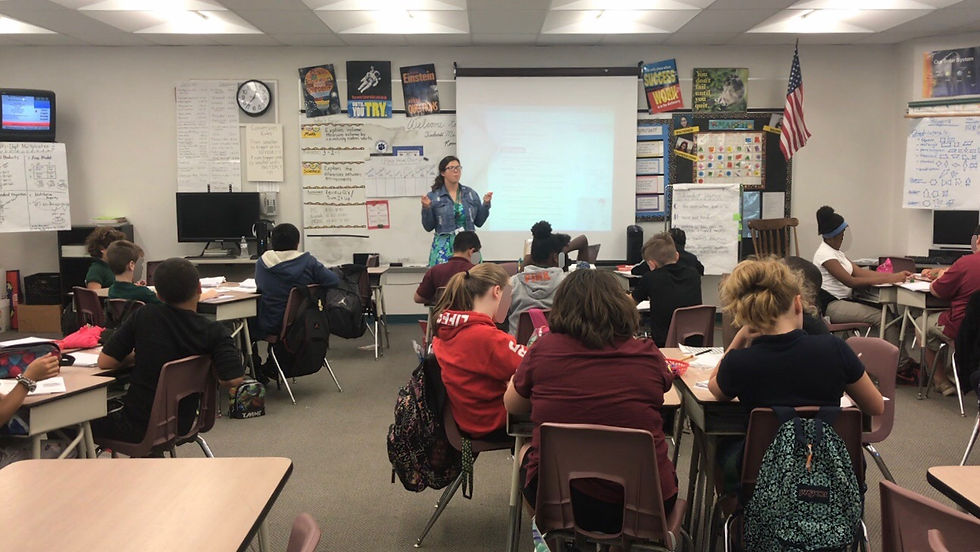
The lesson started out with having the students copy down their focus. I passed out all needed materials for the lesson while the students were writing. I started by asking one of the students to read the focus out loud (3:11). This signals to the students that the instruction is getting ready to begin so all eyes need to be up at the front of the room. Next, I asked the students what the definition of volume is (3:33). Three different students shared their definition. The second student even brought up length times width times height which surprised me because the formula is not something that is expected to be taught in 5th grade (3:57). I realized after the students stated this what she has probably already seen it from I-Ready lessons. I wanted the students to hear another classmate explain what volume is from other peers before writing the actual definition down in their math notebooks, so I called on the third student who hit the nail on the head. The student said that volume is the amount of space that an object takes up (4:24). I repeated the definition for the students to copy down in their notebooks. Next, I had all the students hold up a snap cube. I explained that we are going to use the snap cubes to help us figure out volume. I review the attributes of a three-dimensional figure with the students before diving in to the meat of the lesson. The main attributes that the class discussed were faces and edges (5:03). One student even pointed out that the snap cubes raised side is still a face and I think that helped a lot of students understand what a face truly is (5:54). Next, I moved on to asking what an edge was. The students that I called on made an inappropriate comment about my hair-line, so I subtracted five dollars from his account and continued on with asking another students the same question (6:51). After listening to their responses, I realized that my students understood that each snap cube had 6 faces and 12 edges, so I knew that these students would not struggle with the misconception of counting the faces instead of the whole cubes to find the volume. Next, I attached two snap cubes together. I asked one of my students who was starting to lose focus what the volume of the rectangular prism I had in my hand was (8:07). It took him a couple seconds to realize what I asked him, but he eventually answered the questions correctly (8:26). Since the students were starting to understand the concept, I then had to create a shape with four-unit cubes (8:44). I stressed that it did not have to be a rectangular prism. I then had the students discuss with their shoulder partner as to which figure they believed had the greatest volume. It did not take very long for the students to explain that because each figure had 4 snap cubes, the volume was the same (9:17). Because my students realized that so quickly, I decided that the comparing other shapes for discussion would not be beneficial for my students, so I decided to move on. Next, I called on certain students to state the linear dimensions of their figure. One of my students stated that it had a length of one cubic unit, a width of one cubic unit, and a height of four cubic units and I agreed but this is not true. My CT stepped in to explain that they are not cubic units, but they are linear units (10:22). The students were then able to discuss what a linear unit is while learning a new arm trick that helps the students differentiate between the three (11:43). Once we were done discussing this whole group, I had the students flip to the second page of their packet (13:58). The students were asked to find the volume of the first problem on the paper (14:27). I explained that once the students were done that they needed to go into the back and start on the enrichment activity in the back (14:32). This was a partner activity, so students could slowly but surely start grouping together as they finished the assignment. I made sure they I gave clear directions for this because of the AGP students who needed to leave at one o’clock. Prior to the lesson, I gave them special permission to leave for work ahead to complete the work sheet and enrichment activity before having to leave for their science class. My CT circulated around the room to make sure that they were understanding to assignment before pulling her small group to reteach (14:47-19:11). The rest of the students had to stay focused on me while we discussed the correct answer. Before allowing the students to move on, I explained to them that this is supposed to be an independent activity, so they need to work by themselves. The class decided in the previous week to not work with a timer on the board to make them more accountable for their time. I reminded the students of this and sent them on their way (15:01). Some of the students did not listen and I caught them working together a couple of times (15:14-26:39). I made all students involved subtract money before being allowed to complete the activity. While walking around, I realized that two students, JV and MB, were struggling to understand the content. My CT pulled these two students and started to reteach them the content while the others, slowly but surely, started working on the rest of the sheet and then the enrichment activity (23:42). Throughout this time, I would circulate around the room and take notes about which students understood the content and which ones did not (17:12, 19:22, 20:14, 23:19, 27: 43, & 31:51). During this time, I noticed that NM was refusing to do his work so I walked over to him and start to give him a one on one reteach lesson, but he began to get nasty with me (24:02). After telling him that I do appreciate the way that he was speaking to me, he them started calling himself names and refused to work. I then moved back to circulating giving my other students the help that they needed and wanted (24: 47). After starting to circulate again, I saw that certain students who were struggling with the content were getting assistance from AGP students who were about to start the enrichment activity (24:59, 25:12, 25: 42, & 27:51). Since these students were giving great instruction to their classmates, I allowed them to continue so I could continue circulating. During this time, I noticed a student who was just sitting around. I asked her what was wrong. She said she was embarrassed to do the easier enrichment activity because she did not want anybody making fun of her (29:31). I paired her up with a group of understanding girls that would not make fun of her and she quickly completed the activity, moving on to working with the group of girls. After all of the students completed the worksheet, I gave the student five more minutes to continue working on the enrichment activity. During these five minutes, I heard two great discussions about how dimensions can change if you shift the shape (31:55 & 34:26). After the five minutes were up, I called the students back their seats and explained the assessment to them (35:49). Since this was an introductory lesson, I had the students do an assessment called 3-2-1. The students were to write 3 things that they learned, 2 questions that they had, and 1 thing that they wanted me to know. This assessment takes a lot of time because of the writing so I told the students that we would spend no more than ten minutes on the assessment and then we would move on to science. All students were finished in the amount of time given, passed in the papers, and were ready to start science right on time (46:28).
The aspect of my lesson that was implemented differently was taking out the finding and comparing of the ten-centimeter cubes. This happened because the students understood that no matter the shape of the four snap cubes, they still had the same volume. I did not want to continue to drill something into the students minds that they already understood so I chose to move on and assess the student’s ability to create models and count blocks to find its volume. The thing I would do the same would be allowing students to work at their own pace and allowing them to collaborate when doing the enrichment activity. I would do this because the students did not feel rushed and all, but two students got all the answers correct before moving on to the enrichment activity (15:01). Also, I would still allow them to collaborate while doing the enrichment activity because I heard so many great conversations about the different ways to make the rectangular prisms and how you can shift the shape to find different dimensions (31:55 & 34:26). The thing that surprised me most in my lesson is how well the groups worked together. I allowed the students to group up for the enrichment activity after they finished the page in the packet. Usually when I allow this to happen, I have to constantly remind the students to quiet down and stay focused on their work. I believe that this did not happen because the students were so challenged by the activity and they wanted to complete it in a reasonable amount of time (35:49).
If I were going to teach this lesson to the same group of students, I would set up a second enrichment activity for my students and give them a check point to check with me before moving on. There were quite a few students who were not ready to attempt the thirty-six-cube activity and need to do the one in the packet. My students who were not ready felt embarrassed to have to do the activity in the packet (29:31). Having two papers, one with eight cubes and the other with thirty-six, would make students feel less embarrassed and more willing to learn and collaborate with others. The last thing I would do differently is have the students check their work with me before moving on to the enrichment activity. Thankfully all of the students got the problems right, but there is always a chance that when I am circulating and checking their work I might miss something, and the student will believe what they did was correct, and this could create a misconception.
An individual who had difficulty in today’s lesson is NM. I account for this performance by noting the lack of effort he put towards the tasks. Throughout the year, he has told himself that he is “stupid” or “unable” to do what the rest of the class is doing and shuts down. I kept him by himself and began reteaching the information to him, but he was refusing to listen, so I had to walk away (24:02). My CT and I have been working with him since he arrived in January. The only thing we can do is encourage him to try his best but during this particular lesson, he ended up just looking at the answers from his desk mate and copy them down. This can also be seen because he was unable to do the modified activity with only eight blocks on the front on the packet since there was no one from him to cheat on. I will help this student achieve the learning objectives by pulling him in small groups and rewarding him for the effort that he puts forth every day. The individuals who did especially well in this lesson is my AGP students, SB, AE, LD, KK, PL, JD, EJ, and ZS. I account for this performance by grading their packets and watching how they helped other students that had questions during the enrichment activity (24:59, 25:12, 25: 42, & 27:51). Since they did this, it allowed me to continue to circulate and over see what was going on in the classroom.
Based on what happened in this lesson, the next steps are the introduce the formula to the students. The students already started to make the connection to L x W x H but not to Base x H. The next thing I plan to teach to this class is the formulas using word problems. I will use this information from this evaluation in future lesson planning to plan what numbers my students are ready to use and whether they are ready to find the volume of actual boxes.


Comments