


EDE 4940: Supervisor Observation #2
- Darby Bernaldo
- Mar 13, 2019
- 5 min read


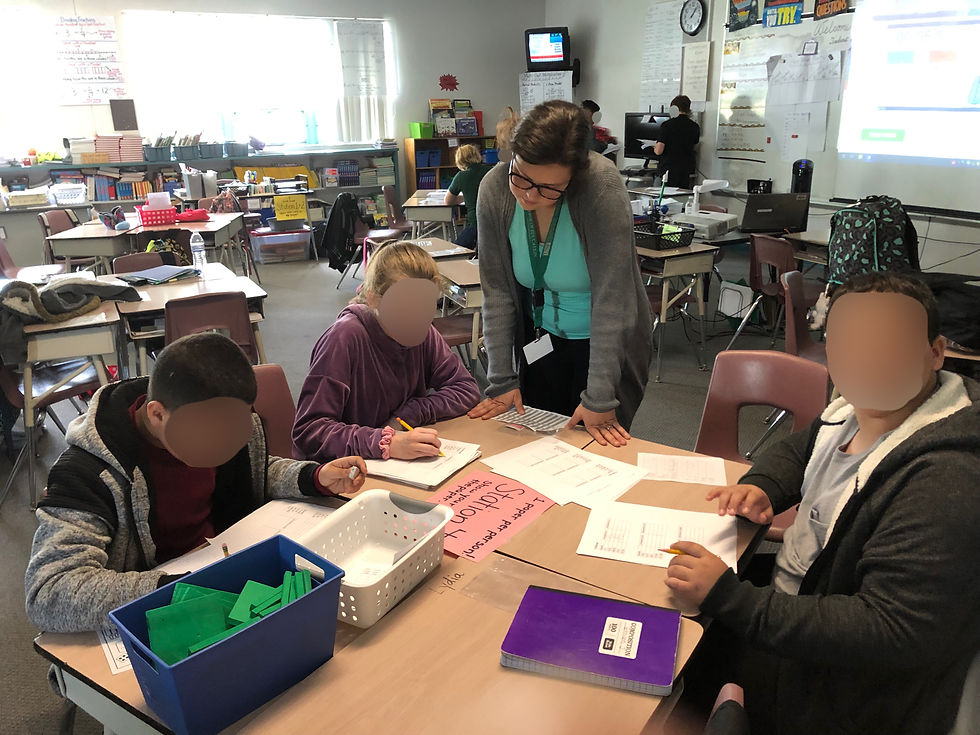
The purpose of this lesson was to review the content taught during the unit of adding, subtracting, and comparing fractions. I started this lesson by having the students write down their focus in their notebooks (0:37-0:53). I then explained that they would be doing a station review. The students were told that they were to visit each of the six stations and they would have seven minutes at each station. The students and I went over the expectations that I had for them. We constantly repeated the expectations over and over again, so they knew there was no excuse for breaking the rules (2:32-6:28). The students were broken up into predetermined groups to get the most out of them and the time we had together. When sending them off to their groups, they began to get a little rowdy. I made them go back to their seats and subtract money from their registers (7:07). They needed to know that their voice level and behavior would not be tolerated throughout the lesson. As soon as everyone was back in their groups at their stations, we began (8:46-53:55). The students worked well in their groups and were mostly silent during their transitions. The students work alongside of an impromptu written self-assessment was taken as their assessment for this lesson letting me know if they were ready to take the common exam (54:12-57:51).
The aspects of my lesson that were implemented differently was when I had my students write what they believe that they understood and what they believe they still struggled with (54:12). This happened because when the students were rating themselves from one to five on their understanding, I got a lot of blank stares. Many of them also asked me if they rated themselves a certain number what does that mean (52:16). That’s when I decided to have them write down their understanding and their struggles. This is something that I learned at the National Association of Profession Development Schools conference that I knew would be beneficial for my students. This gave me a better idea of whether they were ready to take the common exam or not. Doing this regularly is known to aid students in the process of developing metacognition. I was originally going to implement this the week after but I felt like this opportunity was too good to pass up.
If I were to teach this lesson to the same group of students, I would give them a little longer to complete the stations. I really wanted the students to be able to finish all the questions and seven minutes per station was not long enough. So many groups were working well together and producing quality questions, challenging each other to analyze the concepts deeper. Only two groups finished station one and two and they told me how pressed for time they were (34:27 & 41:58). I believe that elongating the time to eight minutes would have helped my students complete all the work and not feel as rushed.
The engagement of the students truly surprised me. The first time I did a station review with the students, they were distracted by many different things. I really wanted to do another station review to see if I could capture my student’s attention better than last time. I wanted to make sure that I went over the directions, so no student would feel lost when doing the activities (2:32-6:28). By having my students come up with the expectations for the lesson and constantly repeat them, I believed they would be more inclined to follow them (8:40). After about the third time of repeating the expectations during transitions, the students were reminding each other and holding each other accountable (32:44).
My teaching method was effective because my CT and I constantly circulated asking questions and probing students to give us answers. Students like to sit back and get answers fed to them but that is not how you learn. By forcing them to struggle, it helps engrain the information in their brain. This can be seen by the conversation across the classroom (18:49, 23:52, 25:14, 33:19, & 42:11). I loved watching the students go back and forth trying to discover the right answers and compare their methods as well. My instructional materials were effective because they were able to keep my students engaged throughout the whole lesson. From the decimal scoot, to the dice game, to struggling to find the error, none of the students were given the chance to feel bored throughout this lesson. One of my students said that this was the most fun he has had learning in a long time (31:38). I believe that I proved you can create a super engaging lesson with a bunch of paper and some eight-sided dice. Even my CT took a copy of everything I planned because she loved the activities so much. That was a real win in my book.
Based on my lesson, the next step was having my students take their common exam. Based off of their understanding from the activities and their self-reflection responses, they were more than ready to take the units test. The next thing I plan to teach is the introductory lesson of multiplying decimals. This is a concept that students struggle with, so I am going to make sure I go slow when introducing this, so the students develop the understanding, so we do not have to constantly review the information. I will use this information from this evaluation in future lesson planning by making sure I allow my students to constantly self-assess themselves. The self-assessment was the final nail in the coffin that showed me the students were ready to take the common exam.
The FEAPs that I completed during this lesson are 3j, 4e, 5d, and 5f. I completed 3j by taking student feedback to monitor instructional needs and adjust instruction to plan when the students are ready to take the unit test. I completed 4e by implementing a folder system that logs all of the student’s grades. The different types of grades that the students log are iReady, quiz, test, and participation. The students take home their folders at the end of the week and discuss each of these grades with their parents. I completed 5d by implementing this folder system and have the students track their goals on the back. Every three weeks, students reevaluate their goals. Lastly, I implemented 5f by taking the knowledge that I learned about student centered instruction from the National Association of Professional Development Schools Conference 2019 and allowing my students to tell me how they feel at the end of my lesson. I evaluate their responses and it gives them a say in how I am giving them instruction.




Comments