


LAE 4424: Classic & Fiction Picture Books
- Darby Bernaldo
- Jun 11, 2018
- 12 min read
Where the Wild Things Are
By Maurice Sendak

Where the Wild Things Are by Maurice Sendak is focused around a young boy who travels to ‘The Land of the Wild Things.’ Upon meeting the Wild Things, he becomes their leader. Despite the fun that he has with the Wild Things, he realizes that home is where the heart is.
This story’s plot is easy for children to follow. The story has an engaging storyline as they are taken into a world that they have never seen before. The limited amounts of words per page separates the story into manageable chunks that keeps the story engaging for students. The story takes place in a realistic setting at the beginning of the story: Max’s room. Afterwords, Max uses his imagination to travel to an imaginary setting: the Land of the Wild Things. It is important for students to make a connection that Max uses his imagination to travel to this place.
One prevalent theme in this text is of exploration and discovering new places. Max explores a whole new world through the use of his imagination. It is extremely important to encourage students to use their imagination and express to them that life does not always have to be so serious. This book truly is a classic that allows students to let go of reality and step into a whole new world.
The illustrations in this text are very engaging and closely align with the words in the text. The illustrations help the students imagine what the wild things may look like and allows them to see the various activities that Max engages in with the wild things. There is a series of pages with no words and only pictures that allows students mind’s to wander free and simply enjoy the story.
The Giving Tree
By Shel Silverstein

The Giving Tree by Shel Silverstein is a tale about a boy, a tree, and selfless love. The boy walks up to the tree every time that he needs something and the tree never hesitates to grant his wishes. This is a classic story that has been read across many generations.
The theme that an be seen in this story is love. This can be seen by everything that the tree provides for him, leaving herself with nothing. Giving and showing love to someone is one of the most rewarding things and this book shows this.
The Shel Silverstein story that was originally published in 1964 does not model diversity. It shows students that showing selfless love is the most rewarding thing.
The illustrations found in this book show what the tree is giving the little boy and how the giving evolves over time. At the end, it also shows students what the tree received in return. Students might have a hard time connecting to this book because the tree is not a real person. It is not giving up things that normal people would and this would need to be related to the students.
Snow White and the Seven Dwarfs
Illustrations by Art Seiden

This story tells the tale of Snow White and her adventures of living with seven dwarfs after fleeing from her evil wicked stepmother who tries to kill her, but in the end she remains the fairest of them all. This classic story as been told time and time again and has been passed down multiple generations to children of all ages.
The theme is blossomed from within the story as readers learn that the evil queen is pretty on the outside but wicked within, but Snow White is the fairest because she is both beautiful physical but also internally. Thus, the theme is that beauty does not last, but that true beauty comes from within.
The Grimms Brothers published this fairytale during the nineteenth century and is known throughout most of the western world. It does not showcase diversity and shows that women solely depend on men to save them.
The illustrations in the book showcase the visual images the original authors tried to display within their writing to further enhance the overall story. One thing students may have difficulty with would be connecting to this version of the story (the plot) because they could be so used to Disney’s rendition that it changes their perception of the original folktale.
Oh the Places You’ll Go!
By Dr. Seuss

Oh the Places You’ll Go! Is a book written by Dr. Seuss. The story refers to a young boy as “you” and he is the initiator of the action in the book. Oh the Place You’ll Go covers the journey of life and the challenges you’ll face.
The illustrations in this book are bright and colorful and encourage the use of imagination. The illustrations correspond with the text and allow students to make connections to what they are reading.
The plot of this story is not completely evident. This story does not have a real storyline but rather shows a list of the places you can go. This book serves to show students that they can do anything they put their mind to despite the challenges they may face.
The Cat in the Hat
By Dr. Seuss
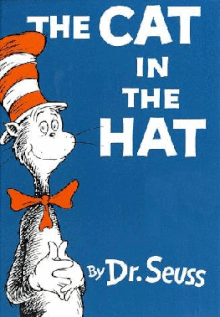
The Cat in the Hat is a book written by Dr. Seuss. The story begins with two siblings, Dick and Sally, that are stuck inside on a rainy day. The children receive an unexpected visitor that turns their whole day upside down.
The theme of The Cat in the Hat revolves around rules and order. The Cat in the Hat is a character that breaks the rules and creates a sense of disorder then calls it ‘fun.’ Meanwhile, another character, who happens to be the childrens’ talking fish, is that sense of authority that is constantly saying, “No!”
The illustrations in this book are fun and engaging. They closely follow with the text and allow for students to relate what they see to what they read.
The plot is fairly simple and easy to follow. Children should be able to understand that the Cat in the Hat is causing disorder and that there is a conflict that needs to be solved. Sometimes, fun can be disorderly!
The Very Hungry Caterpillar
By Eric Carle

The Very Hungry Caterpillar is a children's book by Eric Carle. The appropriate age group is ages 2-5. The book is about a caterpillar who eats more and more every day until he goes into a cocoon and becomes a butterfly. The story follows how much the caterpillar eats and what the caterpillar eats.
The theme of The Very Hungry Caterpillar is educational, teaching children about how caterpillars first come from eggs, live as caterpillars and eat more and more, build cocoons to stay in, and then become butterflies. The book explains the life of a caterpillar in a silly interactive way (some versions of the book have holes in the pages where the caterpillar “ate” the foods) and also includes some educational math by having numbers for example in one page the caterpillar ate four strawberries and the page had illustrations of four strawberries for children to make connections to.
The illustrations in The Very Hungry Caterpillar are very interactive, colorful, and fun. Like mentioned above, some versions of the text contain holes in the illustrations where the caterpillar “ate” the food. All of the illustrations are also very colorful and fun to look at while reading along. The plot is very easy to follow since it’s the same setting the entire time.
Swimmy
By Leo Lionni

Swimmy by Leo Lionni is about a fish named Swimmy, who was different than all of the other fish in his school. When tragedy strikes, Swimmy explores the ocean, and finds a way to bring his friends with him too.
The plot of this story is very easy to follow. It is geared toward students that are in kindergarten, first, and beginning of second grade. This book introduces new forms of wildlife in the ocean. It doesn’t name the different types of wildlife, but it describes them in a fun, childlike way.
The main theme of this book is to not be afraid of going somewhere new because of other people. Swimmy’s new school of fish were afraid of being eaten, so they hid in the dark until Swimmy devised a plan for them to see the world. The lesson of this book is encourage students to get out of their comfort zone, and try new things as well as giving the students an opportunity to explore without the pressure of their fellow classmates. This book is great way to introduce students to the school year.
The illustrations of the book make the story come alive. The way the illustrators conveys Swimmy’s differences shows students that being different is okay. The illustrations cover both pages, and the cover introduces the book without giving away too much.
A Bad Case of Stripes
By David Shannon

A Bad Case of Stripes by David Shannon is about Camilla Cream, a girl that just wants to fit in. At the beginning, Camilla pretends to be someones shes not to impress the people she goes to school with. This leads to something going horribly wrong one day before school.
The plot of the story is easy to follow for all students who are listening or reading. Students have a lot of opportunities to brainstorm and guess what will happen next. The plot is well constructed and teaches kids a great life lesson.
The biggest theme being pushed across in this book is being true to yourself. Instead of being truthful with her family and friends, Camilla lies trying to mask her love of lima beans and who she truly is. All she wants is to be popular at school and keep her group of friends. This all changed when she developed the stripes. All the people that we thought were her friends turned their backs on her. This is when Camilla realizes that being herself is more important than having lots of friends and being popular. This helps her get rid of the stripes. This theme is so important for students of all ages to understand. Students need to know that they do not have to impress anyone and they should always be true to themselves.
The illustrations help enhance the story. They also help the students make connections to the text. The illustrations can be seen on almost every page and some cover both pages. The book is well designed and a true joy to read and discuss with students.
Knock Knock: My Dad’s Dream for Me
By Daniel Beaty

Knock Knock My Dad’s Dream for Me by Daniel Beaty is a short story about a young boy whose father is incarcerated and he expresses to his father in a note how much he misses him and that he hoped that one day he would tell him how to become a man. His father writes back that her won’t be able to but that the young boy will have to knock down the doors he could not.
The theme that can be drawn from this story is how some children grow up in different circumstances and have to rise against the odds stacked against them, whether that be single parent households, incarcerated or absent parents, low income homes, drug, alcohol, or child abuse, or sadly, death. This story is very powerful in that it is told from a child’s perspective and that with strong courage and strength one can beat the odds that society expects them to despite the obstacles they face.
The illustrations created by Bryan Collier are accomplished through different watercolor techniques with a combination of collaging. At the beginning of the story the boy is happy being with his father and as the book progresses the drawings shift the mood to emptiness. Towards the end of the story the mood shifts again to a feeling of hope through the use of warmer and brighter colors.
The plot of this story is a little more complex and has deep meaning compared to most children’s books. This book is geared more towards older elementary students but if the teacher creates a caring environment this book would create strong discussions through the guidance of the teacher.
Chrysanthemum
By Kevin Henke

Chrysanthemum by Kevin Henke is about a young girl mouse who parents and herself love her name, Chrysanthemum. The little mouse is so proud and happy about her name until another girl at her school teases her about it being so long. Chrysanthemum goes home sad to her parents, and her parents remind her that her name is beautiful and unique just like her. She goes back to school happy again with her name.
The biggest theme in the book is to be happy with yourself. That means being happy with every little detail from your looks, to your personality, even to your name. This book teaches children to love themselves and be proud of who they are. After being teased by her friends and coming home sad to her parents, Chrysanthemum remembers that her name is beautiful and unique just like her. This is a great theme and story for children because they may have insecurities or things they don’t like about themselves at the time.
The illustrations are very detailed and enhance the story for the reader. The illustrations show all the phases of the story such as Chrysanthemum the day after she was born, her going to school and being teased, her coming home sad and her parents comforting her, and even more. These illustrations help to make the story more engaging for students. These illustrations also help for ELL students to follow along and understand the story better.
The plots of the story are easy to follow since they only consist of Chrysanthemums house and at school. These are also two plots that children can relate to and understand.
Stellaluna
By Janell Cannon

Stellaluna by Janell Cannon is a story about a young bat named Stellaluna who is separated from her mother by an owl attack. Stellaluna lands in a nest of birds and is in turn raised by them. Stellaluna is clearly different from birds, so she must adapt and learn their ways in order to be accepted.
The plot of this story is fairly easy to follow. The story gives multiple points where students can predict what will happen next. The story moves at a good pace as Stellaluna finally finds out who she really is and who she is meant to be.
One prevalent theme in this story is of acceptance. Stellaluna is a bat whose ways are very different from that of the birds. Though the birds accept having her and raising her, they do not accept that she hangs upside down and flies at night. They attempt to teach her to sleep standing up and to fly during the day. Stellaluna accepts this because she has no other choice. At the end of the story, Stellaluna finds other bats and ultimately, her mother. She is reintroduced to her old and natural ways and expresses to the birds that even though they are different, they are still good friends. Students should be able to understand that differences are not dismissable and that diversity is an asset.
The illustrations in this story are very detailed and closely relate to the text. This makes it feasible for students to make connections to what they are reading. The illustrations are typically on every other page; the text is on the left and the illustrations are on the right.
Lola at the Library
By Anna McQuinn and Rosalind Beardshaw

Lola at the Library by Anna McQuinn and Rosalind Beardshaw is about a young girl named Lola. Lola loves Tuesdays because that’s when she and her mom go to the library. At the library, Lola meets her friends, reads books, the librarian tells stories, and there’s a big machine that scans the books in and out. Lola and her mom always stop on the way home to get a snack. It’s no wonder why Lola loves going to the library.
The plot of the story is quite easy to follow. The height of the story is when Lola finally goes to the library and is able to read with her friends, choose whatever book she wants, and listen to the librarian tell stories. Lola ends her day satisfied with a book read by her mommy.
The main themes of this book is the love of the library and an established routine. Lola loved to go to the library and was excited that it was Tuesday because that’s the day she and her mom spend time at the library. The lesson of this book is to encourage students to go to the library and fall in love with reading. Children love to read and this book allows them to see a child who loves to go to the library and makes a habit out of going. This is a great book to introduce to students coming into Pre-K or Kindergarten.
The illustrations brings the book to life. The vivid colors of the mother and her child on their Tuesday morning routine in their mixed neighborhood is a great addition to the vibrant library scenes. The illustrations help students make connections to the text and to Lola.
References
Cannon, J. (1996). Stellaluna. San Francisco: Living Books.
Shannon, D. (1998). A bad case of stripes. New York: Blue Sky Press.
Lionni, L. (1963). Swimmy. New York : A. Knopf, c1963.
McQuinn, A., & Beardshaw, R. (2009). Lola at the library. Watertown, MA: Charlesbridge.
Henkes, K. (1991). Chrysanthemum. New York : Greenwillow Books, c1991.
Beaty, D., Collier, B., & Bart-Horvath, S. (2013). Knock knock: My dad's dream for me. New
York : Little, Brown and Company, 2013.
Carle, E. (1998). The very hungry caterpillar. Harlow: Longman.
Seiden, A. (1955). Snow White and the seven dwarfs. New York: Treasure Books.
Sendak, M., & Sendak, M. (1963). Where the wild things are. New York: Harper & Row.
Seuss, Dr. (1990). Oh, the places you'll go! New York: Random House.
Seuss, Dr. (1957). The cat in the hat. New York: Random House.
Comments