


LAE 4424: Emergent Picture Books
- Darby Bernaldo
- Jun 11, 2018
- 4 min read
I Can Read With My Eyes Shut!
By Dr. Seuss

I Can Read with My Eyes Shut by Dr. Seuss is a pattern book that constantly repeats “I can read…” This book is a beginner level book for emergent readers. The book supports early language development through repetitive patterns and rhyme schemes. The text is structured with around two sentences per page. Therefore, the text is structured into manageable chunks for emergent readers. This book is appropriate for a child’s attention span due to the basic structure and appropriate amounts of words per page. It may be difficult for a child to make connections to the story since the text is highly imaginary. For example, the text discusses “kangaroo collars” and “Jake the Pillow Snake.” The format of this story is a traditional picture book with illustrations on each page.
The illustrations in this text are full of warm and bright colors that add to the story. The illustrations feature the ‘Cat in the Hat’ which may be familiar to many children. The pictures sometimes span across one page and other times spread over two pages. The pictures connect very closely with the text, which is vital due to the highly imaginative language. For example, ‘Foo Foo the Snoo’ is a figurative creature that is shown through illustrations. Students need these illustrations to create meaning in what they have read. Otherwise, ‘Foo Foo the Snoo’ may be very confusing!
One Fish, Two Fish, Red Fish, Blue Fish
By Dr. Seuss

The book One Fish, Two Fish, Red Fish, Blue Fish, written by Dr. Seuss is a rhyming and opposite book to introduce young children to reading and counting. This book has excellent foundations of phonemic awareness and builds the bridge for children’s schematic knowledge for early phonics instruction. This book also contains lots of rhymes and patterns for children to be able to play along with book. The patterns that are included are opposites such as high and low and fast and slow. Students also see counting in increments (2, 4, 6) in this text.
This literature is relatable to children’s lives because it contains pictures, words, and sounds they are familiar within everyday life. Students can relate to counting on their fingers and brushing hair. However, some elements of the story may be difficult for students to connect to since it is imaginary. For example, students need the illustrations to see what a ‘Ying’ may be. One Fish, Two Fish, Red Fish, Blue Fish is illustrated with bright colors to enhance children’s engagement. The sentence structure is short and simple to make interpretation of the story feasible for children.
Go, Dog. Go!
By Dr. Seuss
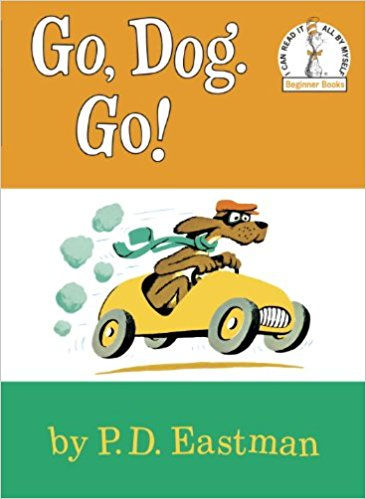
Go, Dog. Go! Is written by Dr. Seuss. The book personifies dogs by having them engage in various activities that they normally would not do. Go, Dog. Go! could be classified as a pattern book for its constant repetition. The sentence structure is short and does not contain a rhyme scheme. The short sentence structure enables children to follow along with the text without being overwhelmed by an abundance of words. This story may lack a connection to a child’s world because not everyone has a dog. This book is appropriate for a child’s attention span because the story is broken down into manageable parts.
Go, Dog. Go! is a picture book that contains illustrations on each page. The illustrations bring the words of the story to life through showing the activities the dogs are doing so students can make visual connections. The various bright colors add to the sense of bewilderment a child may experience when seeing a dog driving a car. The pictures span across one page and sometimes two. The illustrations span across two pages when the text on both pages are directly related to one another.
Twenty-Six Pirates
By Dave Horowitz

The book Twenty-Six Pirates written by Dave Horowitz is a book that goes on an alphabetical journey with good rhymes and adventures. Twenty-six boys, on a pirate ship, named from A to Z join the frogs for adventurous and rambunctious fun. This book is designed for emergent readers and supports early language development through the alphabet and rhyme schemes. The text is structured with one sentence per page which makes it manageable for emergent readers. This book may be difficult for all students to connect or relate to being that there are only boys in the story and not much diversity among the group of boys. Although the author attempts to portray inclusiveness, the book only shows about three persons of color and all the boys look the same.
The illustrations in the text are very dull in terms of colors and complexity. However, each page has its own designated illustrations and letters. The pictures connect to the text which is very important for children to make connections and understand what is being read. For example, there’s a picture of a boy karate kicking a board in half and the page reads, “Pirate Roy. A dangerous boy.” These illustrations help develop the student’s ability to read the text and picture the text in their heads.
Baby Bear, Baby Bear, What Do You See?
By Bill Martin

Baby Bear, Baby Bear, What Do You See? is a rhyming pattern book that takes children through a journey of a variation of animals in the wild. This book has a very simple structure that is easy for children to follow. The story repeats the lines “What do you see?” and has a rhyme scheme that can help early readers predict what is coming next in the story.
The illustrations in the story are bright and colorful. The pictures closely relate to the text and show the animals that are depicted in the text. If a student does not know what one of the animals looks like or cannot make a connection, they can look at the picture to find out what the animal is and what it looks like.
References
Eastman, P. D. (1961). Go, dog, go!. [New York] Beginner Books [1961].
Horowitz, D. H. (2013). Twenty-six pirates: An alphabet book. Penguin Group USA.
Martin, B., & Carle, E. (2016). Baby bear, baby bear, what do you see? NY, NY: Henry Holt and Company.
Seuss, D. (1978). I can read with my eyes shut. New York : Beginner Books, c1978.
Seuss, D. (1960). One fish, two fish, red fish, blue fish. New York, Beginner Books; distributed by Random House, c1960.
Comments